
Most people judge a translation by one thing: fluency. Professionals don’t. A translation can read beautifully and still be wrong—wrong in meaning, wrong in intent, wrong in tone, or wrong for the target audience. That’s why serious translators, localization teams, and translation students use translation evaluation methods that go beyond “sounds good.”
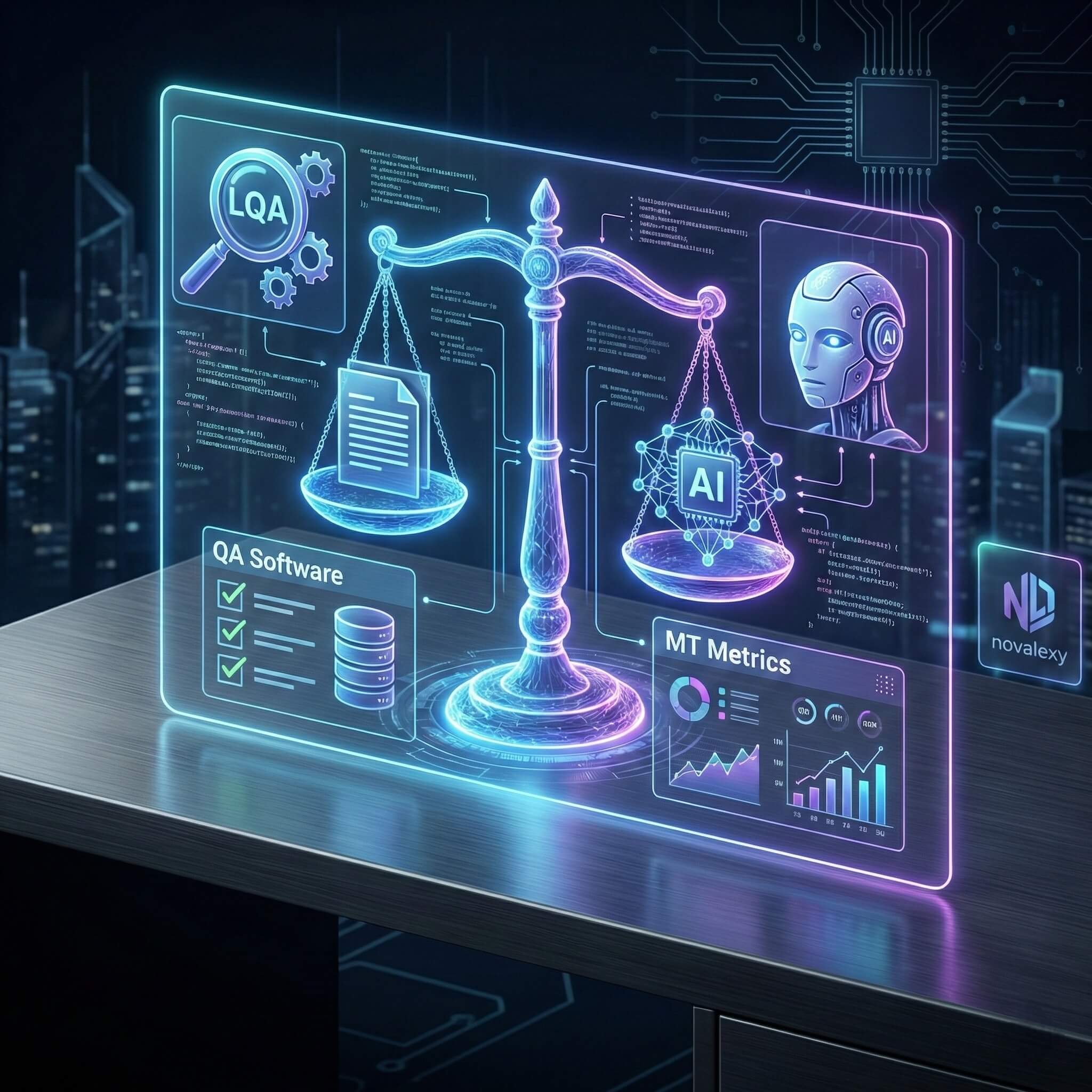
This guide compares the main categories of translation evaluation tools—LQA frameworks, QA software, MT evaluation metrics, and AI evaluators—and shows exactly when each one is the best fit. It also explains what makes an evaluator “professional-grade,” and how to build a workflow that improves quality consistently.
TL;DR: Use QA software (Verifika/Xbench) to catch consistency and mechanical issues. Use LQA frameworks (MQM/DQF) to score vendor quality consistently. Use MT metrics for benchmarking MT engines at scale. If you want explanation-driven evaluation that improves your translation decisions (meaning, tone, terminology, omissions, risk), use an evaluation lab like NovaLexy Playground.
What “Translation Evaluation” Actually Means (And Why It’s Not the Same as QA)
Translation evaluation is the structured assessment of whether a target text achieves the source text’s meaning, intent, tone, and functional effect—at an acceptable level of risk for the audience. It includes linguistic correctness, but it does not stop there.
Translation QA (quality assurance) is usually narrower and more mechanical: it checks consistency, spelling, numbers, tags, punctuation patterns, and term lists. QA is essential—but QA alone cannot tell you if your translation is faithful in meaning, appropriate in register, or pragmatically accurate.
The strongest workflows use both: QA tools to catch avoidable errors, and evaluation tools to judge whether the translation truly works.
Our Methodology: How We Compare Translation Evaluation Tools
To avoid “top 10” fluff, we compare tools using criteria that matter in real translation work:
- Evaluation depth: Can it judge meaning, tone, intent, and audience fit (not just grammar)?
- Repeatability: Can you get consistent results across texts and reviewers?
- Error categorization: Does it classify errors (accuracy, terminology, style, locale, etc.)?
- Severity control: Can it distinguish minor vs major vs critical risk?
- Workflow fit: Does it support students, freelancers, or localization teams?
- Evidence and explanation: Does it explain why something is an issue?
- Practical outcomes: Does it help you improve faster, not just “score” you?
One key point: different tools solve different problems. The “best” tool is the one that matches your goal—benchmarking MT systems, catching technical errors, scoring a job, training a student, or reviewing deliverables at scale.
The Four Categories of Translation Evaluation Tools
1) LQA Frameworks (MQM / DQF)
LQA frameworks are not always “software.” They’re often professional evaluation systems used to classify and score translation errors in a consistent way. If you want repeatable evaluation across people and projects, LQA frameworks are the backbone.
- Best for: localization teams, agencies, vendor management, consistent scoring, quality programs
- Strength: clear categories + severity + repeatability
- Weakness: can feel rigid for learning unless paired with explanation
2) Translation QA Software (Verifika, Xbench, built-in QA in CAT tools)
QA software catches avoidable issues: inconsistent terminology, number mismatches, repeated-word problems, formatting anomalies, punctuation patterns, and compliance with term lists. These tools are extremely valuable—especially for production workflows.
- Best for: consistency checks, terminology enforcement, “did we miss something obvious?”
- Strength: fast, reliable detection of mechanical issues
- Weakness: cannot fully judge meaning, intent, or tone
3) MT Evaluation Metrics (BLEU / COMET / TER, etc.)
Automated metrics are designed for benchmarking machine translation systems at scale. They can be useful in research or when comparing MT engines across datasets. But they should not be the only basis for judging a single human translation’s quality.
- Best for: MT system benchmarking, research, large-scale comparisons
- Strength: scalable, consistent scoring across datasets
- Weakness: weak for nuance, acceptable variation, pragmatics, register
4) AI Translation Evaluators (Explanation + Teaching + Risk Awareness)
AI evaluators can act like a second reviewer—especially when designed to critique translations across multiple dimensions: meaning accuracy, omissions/additions, terminology, tone, cohesion, audience, and risk. The difference between “AI that rewrites” and “AI that evaluates” is huge.
- Best for: students, freelancers, learning workflows, faster improvement loops, second-opinion reviews
- Strength: can explain why something is wrong and propose safer alternatives
- Weakness: must be used carefully for high-stakes content; always apply human judgment
Quick Comparison Table: Which Tool Type Should You Use?
| Goal | Best Tool Type | Why |
|---|---|---|
| Catch terminology/number/consistency issues | QA software (Verifika/Xbench/CAT QA) | Fast detection of mechanical errors and inconsistencies |
| Score translation quality across vendors | LQA frameworks (MQM/DQF) | Standard categories + severity enable repeatable scoring |
| Benchmark MT engines on datasets | MT metrics (BLEU/TER/COMET) | Scalable comparisons across large corpora |
| Improve translation decisions quickly | AI evaluators designed for critique | Explanation + examples + pattern detection accelerates learning |
| Build a “professional reviewer mindset” | AI evaluation lab + LQA checklist | Repeatable practice with structured feedback builds judgment |
The Best Translation Evaluation Tools (By Category)
LQA Frameworks (Professional Evaluation Systems)
- MQM (Multidimensional Quality Metrics): a widely used error taxonomy for translation quality evaluation in professional settings.
- TAUS DQF (Dynamic Quality Framework): a framework and approach for defining quality and capturing quality data.
Translation QA Software (Consistency & Technical Checks)
- Verifika: QA checks focused on consistency, numbers, punctuation patterns, terminology, and formatting issues.
- Xbench: terminology and consistency checks widely used in translation and localization workflows.
- CAT tool QA modules: many CAT tools include QA features that catch basic issues inside your workflow.
MT Evaluation Tooling & Metrics
- BLEU / TER / METEOR: classic metrics used for MT benchmarking (best when used carefully, in context).
- Modern learned metrics: increasingly used in MT research to better approximate human judgment (still not perfect for every scenario).
AI Translation Evaluators (Where NovaLexy Fits)
NovaLexy is an AI translation evaluation lab that audits meaning, tone/register, terminology, omissions/additions, and audience risk—then explains the why behind each issue instead of only rewriting your text.
Many tools can “rewrite” your translation. That’s not evaluation. Real evaluation tells you: what the issue is, why it matters, how severe it is, and what a safer alternative looks like.
NovaLexy Playground is designed as an evaluation lab—not a generic translator. You submit the source + your translation, and it produces structured critique across key professional axes: meaning accuracy, omissions/additions, terminology, register/tone, cohesion, and audience fit. The goal is to help you build the professional “reviewer brain,” not just produce a prettier sentence.
If your goal is to become better at translation (or to review your own work faster and with more confidence), an evaluation-first tool like NovaLexy can sit beside QA software and LQA checklists to create a strong workflow.
Try NovaLexy Playground here — and run the same text through multiple revisions to see which problems repeat.
- Best when: you need structured critique to improve (students, self-review, skill building).
- Also useful when: you want a fast second opinion before delivery (freelancers, QA pass before sending).
What Most Translation “Checkers” Miss
- Meaning drift: fluent but incorrect meaning.
- Pragmatics: politeness, implication, emphasis changes.
- Register mismatch: tone too formal/too casual for the audience.
- Terminology risk: terms that are “correct” but wrong for domain or locale.
Explore more: AI Templates and AI Mentors.
How to Evaluate a Translation Like a Professional (A Practical Checklist)
If you want evaluator-level judgment, use this checklist on every text (even short ones):
- Meaning accuracy: Did the meaning transfer without distortion?
- Omissions/Additions: Did anything disappear or appear that shouldn’t?
- Terminology: Are terms consistent, correct, and audience-appropriate?
- Register & tone: Does the translation match formality, attitude, and intent?
- Pragmatics: Does it produce the same effect (politeness, implication, emphasis)?
- Cohesion & flow: Is the text logically connected and easy to follow?
- Locale fit: Dates, units, punctuation conventions, cultural references.
- Risk: What happens if this is misunderstood? Is there legal/medical/financial exposure?
A simple but powerful habit: track the top 3 recurring error patterns you get in feedback. Fixing patterns, not individual mistakes, is what makes translators improve rapidly.
Recommended Workflow: The “2-Layer Evaluation Stack”
If you want quality that holds up professionally, use a two-layer stack:
- Layer 1 (QA): Run QA checks (consistency, numbers, terminology). Fix those first.
- Layer 2 (Evaluation): Evaluate meaning, tone, pragmatics, audience fit, and risk.
Where NovaLexy fits: it strengthens Layer 2 by turning evaluation into a repeatable process that gives you structured critique, explanations, and improvement guidance. For translators and students, that “evaluation feedback loop” is where skill growth happens.
Who This Guide Is For (And What to Use)
If you’re a translation student
Your fastest improvement comes from structured critique that teaches you how to think. Use QA checks to eliminate avoidable mistakes, then use an evaluation lab like NovaLexy Playground to understand meaning loss, tone shifts, and pragmatic misfires.
If you’re a freelance translator
Use QA tools to reduce “embarrassing” issues, then use evaluation to ensure your choices are defensible. The best freelancers build a repeatable review habit that catches the same problems before clients do.
If you’re an agency or localization team
Use LQA frameworks (MQM/DQF) for scoring across vendors, QA software for consistency enforcement, and evaluation tools to speed up review cycles and train reviewers on recurring error types.