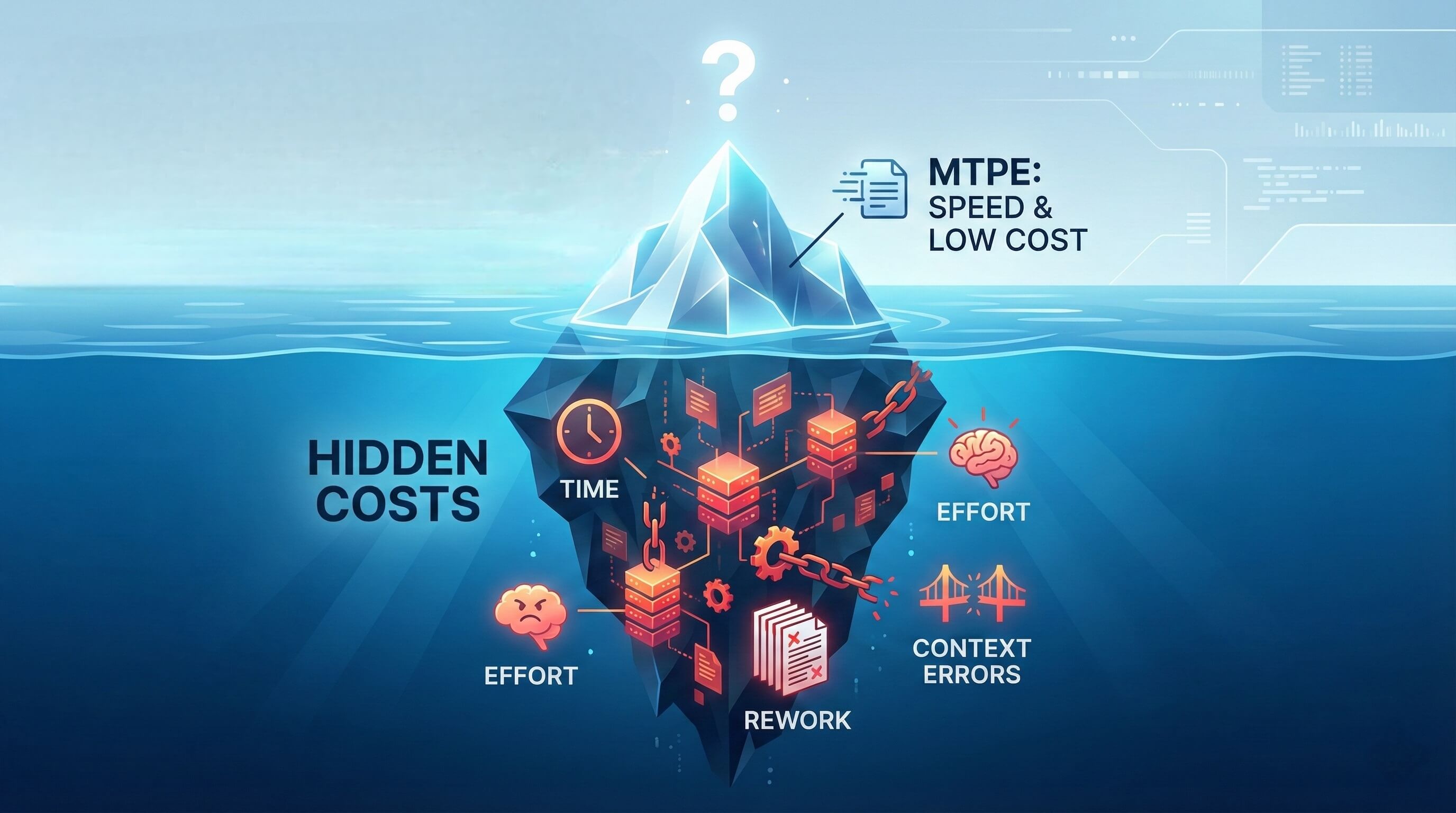

You can pretend AI translation jobs don’t matter. But they’re already shaping your career.
Every translator I know falls into one of two groups. The first group is terrified. They think AI is coming for their livelihood, their clients, their identity. The second group? They’re quietly making more money than ever because they figured out how to ride the wave instead of drowning under it.
Here’s the uncomfortable truth: AI didn’t “arrive.” It’s been here for years. What changed is that companies finally realized they can’t scale global content without it. And now the demand for people who can work with AI — not against it — is exploding.
But most translators are stuck in denial. They’re arguing in Facebook groups about whether AI is “real translation” while agencies are hiring entire teams of AI-focused linguists. They’re debating ethics while clients are rewriting their budgets. They’re clinging to old workflows while the industry quietly moves on.
If you’re reading this, you’re probably feeling the shift. Maybe you’ve seen job posts asking for MTPE experience. Maybe a client asked if you “use AI tools.” Maybe you’ve noticed rates changing. Maybe you’ve wondered if you should adapt or resist.
Good. That means you’re paying attention.
The Feature Story Nobody Wants to Tell
Let me tell you a story that sums up the entire state of AI translation jobs right now. A translator I know — let’s call her Lina — spent 12 years building a solid career. Legal specialization. Strong client base. Good reputation. She wasn’t rich, but she was stable.
Then one of her biggest clients emailed her: “We’re switching to an AI-assisted workflow. We’d like you to handle post-editing.”
She panicked. She felt insulted. She felt like they were asking her to downgrade her skills. She refused.
Three months later, that same client hired a younger translator who accepted the new workflow. He wasn’t better than Lina. He wasn’t more experienced. But he adapted. And now he’s handling triple the volume Lina used to get — at a higher total monthly income — because he works faster with AI support.
Lina didn’t lose her job to AI. She lost it to someone who knew how to work with AI.
That’s the real story of AI translation jobs. Not replacement. Not extinction. Redistribution.
Why This Article Exists
This isn’t another “AI won’t replace translators” bedtime story. And it’s not a doom-and-gloom prophecy either. It’s a reality check — the kind translators desperately need but rarely get.
Because here’s the truth: AI translation jobs aren’t the future. They’re the present. And the translators who understand how these jobs work — where they come from, how they pay, what skills they require — are the ones who will dominate the next decade.
This article will show you exactly how the industry is shifting, where the real opportunities are, and how to position yourself so you’re not just surviving — you’re thriving.
And yes, we’ll talk about the uncomfortable parts too. The rate drops. The workflow changes. The expectations. The pressure. The mistakes translators make that cost them thousands.
But we’ll also talk about the upside. The new roles. The new income streams. The new ways to work smarter, not harder. The tools that actually help instead of slow you down. Including the NovaLexy Playground and the AI Templates that many translators use to speed up their workflow.
By the time you finish this article, you’ll know more about AI translation jobs than 99% of translators. And you’ll be able to make decisions based on reality, not fear.
Let’s Start With the Big Question
What exactly counts as an “AI translation job”? Most translators think it’s just MTPE — machine translation post-editing. But that’s only one piece of the puzzle. The truth is much bigger, and much more interesting.
In the next section, we’ll break down every type of AI-related translation job that exists today — including the ones nobody talks about, the ones that pay surprisingly well, and the ones you should avoid.
The Full Breakdown: What Counts as an AI Translation Job Today?
Most translators think “AI translation jobs” means one thing: MTPE. And yes, MTPE is a huge part of it. But the industry has quietly expanded far beyond that. Companies aren’t just looking for translators anymore — they’re looking for linguists who can guide, correct, supervise, and improve AI systems.
Here’s the real list. The one agencies use internally. The one job boards don’t explain. The one most translators never see.
1. Machine Translation Post-Editing (MTPE)
This is the job everyone knows — and the one everyone loves to hate. But here’s the truth: MTPE isn’t going anywhere. In fact, it’s growing. Companies rely on it because it’s fast, scalable, and predictable.
But MTPE isn’t just “fixing AI mistakes.” It’s a skill. A real one. A profitable one if you know how to position yourself. The translators who treat MTPE like a professional service — not a downgrade — are the ones earning the most from it.
- Light MTPE: Quick corrections, minimal rewriting.
- Full MTPE: Deep editing, restructuring, terminology alignment.
- Specialized MTPE: Legal, medical, finance — where AI still fails hard.
Specialized MTPE is where the money is. Not general content. Not marketing fluff. Not random blog posts. If you want to earn real income from MTPE, niche down.
2. AI-Assisted Human Translation
This is the sweet spot. You translate normally, but you use AI as a support tool — not a replacement. Think of it like having a junior assistant who works fast but needs supervision.
Companies love this workflow because it blends speed with quality. Translators love it because it cuts their time in half without cutting their rates.
And if you use the right tools — like the NovaLexy Playground — you can test multiple translation variations instantly and choose the best one.
3. Real-Time AI Translation Supervision
This is one of the fastest-growing AI translation jobs, and almost nobody talks about it. Companies use AI for live meetings, webinars, and support calls — but they still need a human to monitor the output and correct errors on the fly.
It’s like being an interpreter, but instead of speaking, you’re supervising. And yes, it pays well because it’s high-pressure and high-value.
- Zoom meetings
- Live events
- Customer support calls
- Training sessions
If you’re fast, accurate, and calm under pressure, this niche is a goldmine.
4. AI Training Data Creation
AI doesn’t learn from magic. It learns from data — and that data has to be created, cleaned, and validated by humans. That’s where translators come in.
Training data jobs include:
- Creating example translations
- Rating AI outputs
- Correcting AI mistakes
- Writing prompts
- Evaluating tone, accuracy, and style
These jobs pay surprisingly well because they require linguistic judgment, not just speed.
5. AI Quality Assurance (Linguistic QA)
Think of this as the “final boss” of AI translation jobs. You’re not translating. You’re not editing. You’re evaluating the entire output for:
- Accuracy
- Terminology
- Consistency
- Brand voice
- Formatting
- Compliance
Companies rely on QA linguists to ensure AI doesn’t embarrass them. And trust me — AI embarrasses companies all the time.
6. Hybrid Roles (The Future of Translation Work)
These are the roles that didn’t exist five years ago but are now popping up everywhere:
- AI Localization Specialist
- AI Prompt Linguist
- AI Workflow Manager
- AI Content Reviewer
- AI Linguistic Consultant
These roles pay more because they require a mix of translation skill, technical understanding, and workflow management. They’re perfect for translators who want to move up the value chain.
7. The Jobs You Should Avoid
Not all AI translation jobs are worth your time. Some are traps. Some are scams. Some are so underpriced they’re practically charity work.
Avoid:
- Jobs paying per hour with unrealistic expectations
- Jobs paying per word for MTPE (red flag)
- Jobs with “AI evaluation” but no clear guidelines
- Jobs that require unpaid tests longer than 10 minutes
- Jobs that promise “exposure” instead of money
If a job sounds too good to be true, it usually is. If it sounds too vague, it’s probably chaos. And if it pays pennies, walk away.
Why This Breakdown Matters
Most translators only see the surface. They see MTPE and panic. They see AI and assume the worst. But the industry is much bigger than that. There are dozens of roles — some new, some evolving, some hidden — and they all fall under the umbrella of “AI translation jobs.”
Understanding the full picture is the first step to positioning yourself where the money actually is.
In the next section, we’ll talk about the part everyone cares about: money. Which AI translation jobs pay well, which ones don’t, and how to avoid getting underpriced.
The Part Everyone Cares About: How Much Do AI Translation Jobs Pay?
Let’s stop pretending. Every translator wants to know the same thing: “Is there real money in AI translation jobs, or is it just another excuse to pay us less?”
Here’s the truth — and it’s not what most translators expect.
AI translation jobs don’t pay less by default. They pay less when you accept low-value work. They pay more when you understand the economics behind them. The translators who complain the loudest are usually the ones who never learned how to position themselves.
So let’s break down the real numbers. Not the fantasy rates. Not the agency propaganda. The actual income ranges translators are earning right now.
MTPE Rates: The Good, the Bad, and the Ugly
MTPE has a reputation for being underpaid — and yes, some agencies absolutely abuse it. But the translators who know how to negotiate, specialize, and set boundaries are earning solid income from it.
Here’s the breakdown:
- Low-end MTPE: $0.01–$0.02 per word (avoid this)
- Mid-range MTPE: $0.03–$0.05 per word (standard)
- High-end MTPE: $0.06–$0.10 per word (specialized fields)
Specialized MTPE — legal, medical, finance, patents — pays the highest because AI still struggles with nuance, terminology, and liability-heavy content.
If you’re earning less than $0.03 per word, you’re not in the MTPE market. You’re in the exploitation market.
AI-Assisted Human Translation Rates
This is where the money gets interesting. Companies are willing to pay full translation rates if you use AI as a support tool — not a replacement.
Typical rates:
- Standard translation with AI support: $0.08–$0.14 per word
- Specialized translation with AI support: $0.15–$0.25 per word
Why so high? Because the client gets the best of both worlds: speed and quality. And if you use tools like the NovaLexy Playground, you can produce multiple variations instantly, choose the best one, and deliver faster without sacrificing quality.
Real-Time AI Translation Supervision Rates
This niche pays extremely well because it’s high-pressure and requires fast thinking. You’re essentially acting as a safety net for AI during live events.
Rates vary widely:
- Entry-level supervision: $20–$35 per hour
- Mid-level supervision: $40–$60 per hour
- Specialized or high-stakes events: $75–$120 per hour
If you have interpreting experience, this niche is a goldmine. If you don’t, you can still break in — but you need speed, accuracy, and nerves of steel.
AI Training Data Jobs: The Hidden Income Stream
These jobs are underrated. They don’t feel like “translation,” but they pay well because they require linguistic judgment.
Typical pay:
- Data creation: $15–$25 per hour
- Data evaluation: $20–$35 per hour
- Prompt writing: $25–$45 per hour
- AI output rating: $18–$30 per hour
These jobs are perfect for filling gaps between larger projects. They’re flexible, remote, and consistent.
AI QA (Quality Assurance) Rates
QA is where the highest-paying AI translation jobs live. Companies rely on QA linguists to prevent embarrassing mistakes — and they’re willing to pay for that safety.
Typical rates:
- General QA: $0.04–$0.07 per word
- Specialized QA: $0.08–$0.12 per word
- Hourly QA: $35–$60 per hour
If you’re detail-oriented and have strong subject-matter expertise, QA is one of the most profitable niches in the AI translation world.
Hybrid Roles: The New High-Income Path
These roles pay the most because they require a mix of translation skill, technical understanding, and workflow management.
Typical salaries:
- AI Localization Specialist: $55,000–$95,000 per year
- AI Prompt Linguist: $60,000–$110,000 per year
- AI Workflow Manager: $70,000–$120,000 per year
- AI Content Reviewer: $45,000–$75,000 per year
- AI Linguistic Consultant: $80,000–$150,000 per year
These roles are perfect for translators who want to move beyond per-word pricing and into stable, high-value positions.
The Hard Truth About Rates
Here’s the part most translators don’t want to hear: the market isn’t paying less because of AI. It’s paying less because translators accept less.
Agencies will always try to lower costs. That’s their job. Your job is to know your value, understand the market, and negotiate like a professional.
The translators earning the most from AI translation jobs aren’t the fastest. They’re the ones who understand how to position themselves.
How to Avoid Getting Underpaid
If you want to avoid the low-end trap, follow these rules:
- Never accept MTPE per-word rates below $0.03.
- Always charge more for specialized content.
- Offer AI-assisted translation instead of MTPE when possible.
- Track your speed and use it as leverage.
- Use tools that increase your output without lowering quality.
- Say no to clients who treat you like a machine.
In the next section, we’ll talk about the part that separates winners from losers: skills. The exact skills you need to thrive in AI translation jobs — and the ones that will hold you back.
The Skills That Separate Translators Who Thrive From Those Who Fade Away
Let’s be brutally honest: most translators aren’t losing work because of AI. They’re losing work because they never updated their skills. The industry changed, and they didn’t. Clients aren’t looking for “just translators” anymore. They’re looking for linguists who can operate in an AI-driven workflow without falling apart.
If you want to stay relevant — and profitable — you need to master a new set of skills. Not technical skills. Not coding. Not engineering. Just the skills that modern translation work actually requires.
1. Speed Without Sloppiness
AI translation jobs reward speed — but only if the quality stays high. The translators who thrive are the ones who can move fast without losing accuracy. That means:
- Knowing when to trust AI output
- Knowing when to rewrite from scratch
- Recognizing patterns in AI errors
- Editing with intention, not hesitation
Speed is a skill. Not a personality trait. You can train it. And if you don’t, someone else will take the job you wanted.
2. Understanding AI Strengths and Weaknesses
AI is not your enemy. It’s not your replacement. It’s a tool — and like any tool, it has strengths and weaknesses. The translators who succeed are the ones who know exactly where AI fails.
AI is strong at:
- Simple sentences
- Predictable patterns
- Common terminology
- High-volume content
AI is weak at:
- Ambiguity
- Idioms
- Legal nuance
- Medical precision
- Brand voice
- Emotion
If you can identify these weaknesses instantly, you become indispensable.
3. MTPE Technique (The Skill Most Translators Lack)
Most translators think MTPE is “just editing.” It’s not. It’s a technique. A workflow. A mindset. And if you don’t understand it, you’ll either work too slowly or produce sloppy results.
Good MTPE requires:
- Scanning for structural errors
- Fixing terminology inconsistencies
- Rewriting unnatural phrasing
- Maintaining the client’s voice
- Knowing when to stop editing
Yes — knowing when to stop is a skill. Over-editing kills your speed. Under-editing kills your quality. Balance is everything.
4. Prompting Skills (The New Linguistic Superpower)
Prompting isn’t just for developers. Translators who know how to prompt AI properly can produce better drafts, faster. Prompting is basically giving instructions — but with precision.
Good prompting includes:
- Specifying tone
- Defining terminology
- Setting context
- Providing examples
- Requesting multiple variations
If you can prompt well, you can produce better translations in half the time. Tools like the AI Templates help you build prompts that actually work.
5. Subject-Matter Expertise
This is the one skill AI can’t fake. And it’s the one skill that guarantees you’ll never be replaced. If you know a field deeply — law, medicine, finance, engineering — you will always be needed.
AI can guess. You can understand. That’s the difference.
6. Quality Judgment (The Skill Clients Pay For)
AI can produce text. But it can’t judge quality. It can’t tell if something “sounds right.” It can’t detect subtle errors. It can’t feel tone. That’s your job.
Quality judgment is what separates a translator from a machine. It’s what clients pay for. It’s what keeps you relevant.
7. Workflow Efficiency
Translators who thrive in AI translation jobs don’t just translate. They manage their workflow like professionals. That means:
- Using CAT tools properly
- Organizing terminology
- Batching tasks
- Automating repetitive steps
- Using AI tools to speed up prep work
If your workflow is slow, your income will be slow. If your workflow is efficient, your income will grow — even if your rates stay the same.
8. Emotional Resilience
This one matters more than people admit. The translators who survive the AI shift are the ones who don’t panic every time a new tool comes out. They adapt. They learn. They stay calm.
Fear kills careers faster than AI ever will.
The Skills That Don’t Matter Anymore
Let’s be honest. Some skills that used to matter simply don’t anymore. Not because they’re useless — but because AI handles them well enough.
These include:
- Basic grammar correction
- Literal translation
- Simple terminology lookup
- Repetitive phrasing
If your entire workflow depends on these tasks, you’re in trouble. But if your value comes from judgment, nuance, and expertise, you’re safe.
Why Skills Matter More Than Ever
AI didn’t kill translation. It killed mediocrity. The translators who relied on slow workflows, outdated methods, and generic skills are the ones struggling. The ones who adapt — even slightly — are thriving.
In the next section, we’ll talk about the part that determines whether you get hired or ignored: your positioning. How you present yourself. How you pitch your services. How you stand out in a market flooded with AI tools and low-cost competitors.
How to Position Yourself So Clients Choose You Over AI (and Over Other Translators)
You can have all the skills in the world, but if your positioning is weak, you’ll get ignored. Translators love to blame AI for their lack of clients, but the truth is simpler: most translators present themselves exactly the same way.
Same generic profile. Same generic pitch. Same generic “I translate from X to Y” introduction. No wonder clients treat them like interchangeable parts.
If you want to stand out in the era of AI translation jobs, you need to position yourself like a specialist — not a commodity.
1. Stop Selling “Translation.” Start Selling Outcomes.
Clients don’t care about translation. They care about what translation does for them. They want:
- Fewer errors
- Faster turnaround
- Consistent terminology
- Brand-safe content
- Legal compliance
- Better customer experience
If your pitch is “I translate documents,” you’re invisible. If your pitch is “I help companies avoid legal mistakes in multilingual contracts,” you’re valuable.
2. Make AI Part of Your Value — Not Your Competition
Most translators hide from AI. They pretend they don’t use it. They act like it’s shameful. Meanwhile, clients are actively searching for linguists who can work with AI tools.
Here’s the truth: clients don’t want translators who reject AI. They want translators who control it.
So instead of saying “I don’t use AI,” say this:
“I use AI strategically to speed up my workflow while ensuring human-level accuracy and subject-matter expertise.”
That sentence alone puts you ahead of 80% of translators.
3. Build a Portfolio That Shows Your Process
Most translators show before/after samples. That’s fine, but it’s not enough anymore. Clients want to see how you think. How you edit. How you improve AI output.
Your portfolio should include:
- AI output vs. your corrected version
- Terminology decisions
- Style adjustments
- Brand voice improvements
- Examples of MTPE corrections
When clients see your process, they trust you instantly.
4. Use Tools That Make You Faster (and Tell Clients You Do)
Clients love efficiency. They love consistency. They love workflows. If you use tools like the NovaLexy Playground to test variations or the AI Templates to speed up prep work, mention it.
It signals professionalism. It signals modernity. It signals that you’re not stuck in 2012.
5. Specialize Like Your Career Depends On It (Because It Does)
Generalists are the first to lose work to AI. Specialists are the last. If you want to survive the next decade, you need a niche.
Here are the niches that thrive in AI-driven workflows:
- Legal translation
- Medical translation
- Finance and banking
- Technical manuals
- Software localization
- Pharmaceuticals
- Engineering
AI struggles with nuance. You don’t. That’s your advantage.
6. Rewrite Your Profiles to Match AI-Era Demand
Your Upwork, Fiverr, LinkedIn, and agency profiles should not look like they did five years ago. They should reflect the new reality of translation work.
Here’s what clients want to see:
- “Experienced in AI-assisted translation workflows.”
- “Skilled in MTPE and linguistic QA.”
- “Specialized in [your niche].”
- “Efficient, accurate, and consistent.”
- “Comfortable working with modern AI tools.”
If your profile doesn’t say these things, you’re invisible in 2026.
7. Build a Personal Brand That Doesn’t Sound Like Everyone Else
Translators love to sound formal. Polished. Safe. But safe doesn’t stand out. Safe doesn’t get shared. Safe doesn’t get hired.
Your brand should reflect:
- Your personality
- Your expertise
- Your opinions
- Your workflow
- Your value
Clients want to hire humans, not robots. Ironically, the more AI enters the industry, the more human your brand needs to be.
8. Show That You Understand AI Better Than the Client
Clients don’t want to manage AI. They want someone who can manage it for them. If you can explain AI workflows clearly, you become the expert they rely on.
For example:
- Explain when AI is appropriate
- Explain when human translation is required
- Explain how you combine both
- Explain how you ensure quality
When you educate clients, you control the conversation. And when you control the conversation, you control the rates.
9. Stop Competing on Price. Compete on Value.
AI translation jobs attract low-cost competitors. Don’t join them. Don’t race to the bottom. Race to the top.
Clients will always pay more for:
- Speed
- Accuracy
- Specialization
- Reliability
- Professionalism
- Clear communication
Cheap translators lose clients. Valuable translators keep them.
10. The Positioning Formula That Works Every Time
If you want a simple formula to stand out in the AI era, here it is:
“I help [type of client] achieve [specific outcome] through [your niche] using a combination of human expertise and AI-assisted workflows.”
This positioning statement is powerful because it tells clients:
- Who you help
- What you do
- How you do it
- Why you’re different
In the next section, we’ll talk about the part that scares translators the most — the future. What AI will actually change, what it won’t, and how to stay ahead of the curve instead of reacting to it.
The Future of AI Translation Jobs: What’s Actually Coming Next
Everyone loves to make predictions about AI. Most of them are wrong. Some are fear-driven. Some are hype-driven. But the truth sits somewhere in the middle — and it’s far more practical than people think.
AI will keep getting better. That’s guaranteed. But it won’t replace translators who understand nuance, context, and subject-matter expertise. What it will replace are outdated workflows, slow processes, and translators who refuse to adapt.
The future of AI translation jobs isn’t about machines taking over. It’s about humans who know how to work with machines becoming the most valuable people in the industry.
The Hard Truth
Let’s stop sugarcoating it. The translators who struggle the most in the AI era are the ones who cling to the past. They want the industry to stay the same. They want clients to value the same things they valued ten years ago. They want to pretend AI doesn’t exist.
But the industry doesn’t care what translators want. It cares about speed, scale, and consistency. And AI delivers all three — with one major flaw: it still needs humans to guide it.
That’s where you come in. Not as a replacement for AI. Not as a victim of AI. But as the person who makes AI usable, reliable, and safe.
The translators who thrive in the next decade will be the ones who stop fighting AI and start mastering it.
How to Fix Your Career Starting Today
If you want to stay relevant — and profitable — in the world of AI translation jobs, here’s the roadmap. Follow it, and you’ll be ahead of 95% of translators.
- 1. Pick a niche. Generalists drown. Specialists rise.
- 2. Learn MTPE properly. Not casually. Professionally.
- 3. Use AI tools strategically. Don’t hide from them.
- 4. Build a portfolio that shows your process. Not just your results.
- 5. Update your profiles to reflect AI-era skills. Clients search for them.
- 6. Charge based on value, not fear. Low rates attract low-quality clients.
- 7. Use tools like the NovaLexy Playground to speed up your workflow.
- 8. Use the AI Templates to build prompts and structures that save hours.
- 9. Stay emotionally resilient. Fear kills careers faster than AI.
- 10. Position yourself as the human expert who controls AI.
This isn’t about surviving. It’s about evolving. And evolution always favors the adaptable.
Final Take
AI translation jobs aren’t a threat. They’re a shift — a massive one — but a shift that creates more opportunities than it destroys. The translators who win are the ones who understand the new rules, master the new tools, and position themselves as experts in a world where AI is everywhere.
You don’t need to be the fastest. You don’t need to be the smartest. You just need to be the translator who understands how the industry is changing and adapts before everyone else.
Because here’s the truth: AI won’t replace translators. But translators who use AI will replace translators who don’t.
FAQ
Are AI translation jobs real or just hype?
They’re very real. Companies are hiring for MTPE, AI-assisted translation, QA, training data creation, and hybrid roles every day. The demand is growing, not shrinking.
Can translators work remotely in AI-related roles?
Yes. Most AI translation jobs are remote because the work is digital, workflow-based, and doesn’t require physical presence.
Will AI replace translators completely?
No. AI replaces low-skill, slow, or outdated workflows. It does not replace subject-matter expertise, nuance, or human judgment. Translators who adapt will thrive.
Frequently Asked Questions
They’re very real. Companies are hiring for MTPE, AI-assisted translation, QA, training data creation, and hybrid roles every day. The demand is growing, not shrinking.
Yes. Most AI translation jobs are remote because the work is digital, workflow-based, and does not require physical presence.
No. AI replaces low-skill, slow, or outdated workflows. It does not replace subject-matter expertise, nuance, or human judgment. Translators who adapt will always thrive.