
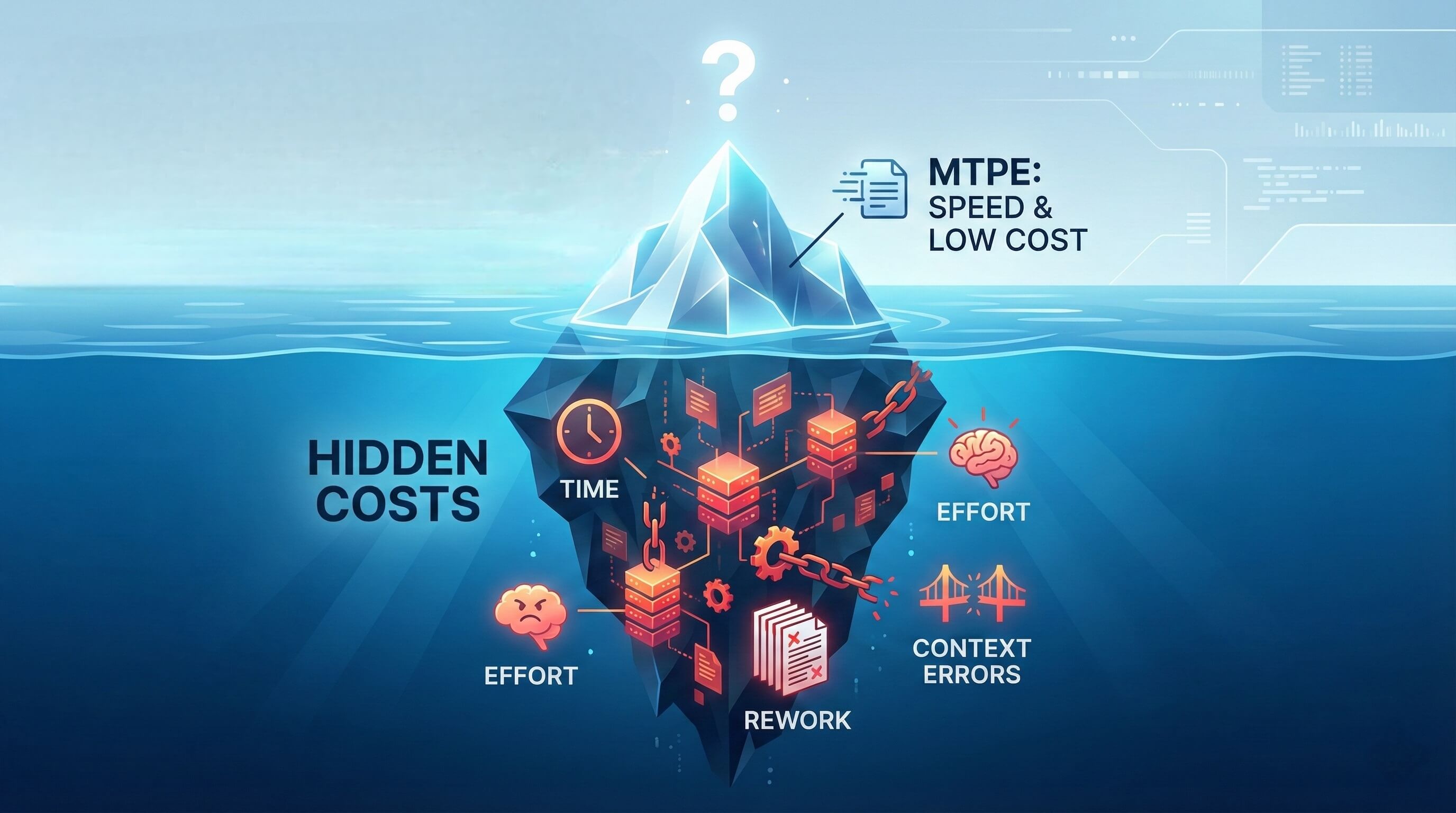
Machine translation post‑editing (MTPE) has become one of the most aggressively promoted workflows in the translation industry. Agencies pitch it as a cost‑saving miracle. Clients see it as a way to scale content faster. And translators are told it’s the “future of the profession” — whether they like it or not.
But beneath the marketing, the spreadsheets, and the promises of efficiency lies a reality that many professionals only discover once they’re deep in the workflow: MTPE is full of hidden costs. Financial costs. Quality costs. Human costs. Operational costs. And long‑term strategic costs that can quietly damage brands, teams, and careers.
This article exposes those hidden costs — the ones that don’t show up in per‑word rates or sales presentations — and explains why MTPE is often far more expensive than it appears.
To understand the broader context, it helps to look at how the industry is shifting. NovaLexy’s article on AI translation jobs in 2026 shows how AI is reshaping roles, expectations, and workflows. And the long‑running debate around whether AI will replace translators highlights the tension between automation and human expertise. MTPE sits right in the middle of that tension, and that’s where the hidden costs begin.
1. The financial illusion: lower rates, higher effort
MTPE is almost always sold with reduced per‑word rates. Agencies justify this by claiming the machine has already done “70–80% of the work.” But translators know this number is pure fiction. In many language pairs, MT output is barely usable. Even when it’s grammatically correct, it often lacks nuance, tone, and domain‑specific accuracy.
Translators frequently report that MTPE takes as long as "or longer than" translating from scratch. Why?
Because editing bad writing is harder than writing well.
The hidden financial cost is simple: MTPE lowers income while increasing effort.
When translators calculate their effective hourly rate, many discover that MTPE pays significantly less than traditional translation, even though the cognitive load is higher.
2. The unpaid time nobody talks about
MTPE projects rarely arrive in a clean, ready‑to‑edit format. Translators often spend unpaid time:
-
fixing segmentation errors
-
cleaning messy source files
-
correcting machine hallucinations
-
aligning terminology with glossaries
-
rewriting entire paragraphs the MT engine butchered
None of this is reflected in the per‑word rate.
This unpaid time is one of the biggest hidden costs of MTPE — and one of the least discussed.
3. The quality risks that quietly destroy trust
MT engines make mistakes that are subtle, plausible, and dangerous. They produce sentences that look correct at a glance but contain:
-
incorrect terminology
-
mistranslated idioms
-
tone inconsistencies
-
culturally inappropriate phrasing
-
factual inaccuracies
These errors are easy to miss when editors are under pressure to work fast.
When they slip through, the cost is enormous:
-
brand damage
-
customer confusion
-
legal exposure
-
expensive rework
-
loss of trust
This is especially true in high‑risk domains like legal, medical, and financial translation — areas where MTPE should never be used, yet often is.
For a deeper look at how language impacts global visibility, NovaLexy’s article on international SEO shows how even small linguistic errors can affect performance. MTPE magnifies that risk.
4. The cognitive fatigue nobody budgets for
MTPE is mentally exhausting in a way that traditional translation is not. Translators describe it as:
-
“fighting the machine”
-
“untangling someone else’s bad writing”
-
“fixing errors instead of creating meaning”
This type of work creates cognitive fatigue because the brain must constantly switch between:
-
reading
-
evaluating
-
correcting
-
rewriting
-
checking for subtle errors
It’s a high‑load, low‑autonomy workflow — the worst combination for long‑term mental health.
Burnout is a hidden cost that agencies rarely acknowledge, but it affects productivity, quality, and retention.
5. The operational chaos for agencies
Agencies often underestimate the complexity of implementing MTPE at scale. They must:
-
evaluate MT quality by domain
-
train project managers
-
redesign QA workflows
-
manage translator resistance
-
handle client expectations
-
troubleshoot engine failures
-
maintain terminology consistency
This operational overhead consumes time and money — often more than the savings MTPE was supposed to generate.
When MTPE is pushed too aggressively, agencies experience higher turnover among their best translators. Replacing experienced linguists is expensive, and quality drops as new vendors cycle in.
6. The misalignment between sales and reality
Sales teams love MTPE because it sounds futuristic and cost‑efficient. But when they promise unrealistic timelines and low prices, operations teams are left to deal with the fallout.
This misalignment leads to:
-
rushed projects
-
unrealistic expectations
-
quality failures
-
strained client relationships
The long‑term cost of losing a client due to poor MTPE quality far outweighs the short‑term savings.
7. The strategic cost: when “good enough” becomes dangerous
MTPE encourages a mindset of “good enough.” But in competitive markets, “good enough” is a losing strategy.
Brands that rely too heavily on MTPE risk:
-
sounding generic
-
losing cultural nuance
-
weakening their brand voice
-
damaging customer trust
-
falling behind competitors who invest in quality
This is especially true in marketing, where tone, emotion, and cultural resonance matter. MTPE cannot replicate these elements reliably.
8. When MTPE actually makes sense
Despite its flaws, MTPE is not useless. It works well when:
-
content is low‑risk
-
the MT engine performs well in that domain
-
translators are paid fairly
-
QA processes are robust
-
timelines are realistic
In these cases, MTPE can be a useful tool — not a default workflow.
9. How translators can protect themselves
Translators can reduce the hidden costs of MTPE by:
-
tracking actual time spent
-
negotiating higher rates for poor MT output
-
refusing MTPE for high‑risk content
-
setting quality thresholds
-
requesting samples before accepting projects
-
documenting cases where MTPE is inefficient
This data empowers translators to push back against unrealistic expectations.
10. The real question: is MTPE worth it?
MTPE is not inherently good or bad. It is a tool one that can be useful or harmful depending on how it’s used.
But the industry must stop pretending MTPE is a simple cost‑saving solution. It is a complex workflow with hidden financial, human, and operational costs.
Clients who want to scale content responsibly must understand these costs. Agencies must stop overselling MTPE as a miracle solution. Translators must protect their time, rates, and professional integrity.
Only then can MTPE be used strategically, instead of destructively.